
Claude Code + MCP - Make Video, Images and Music Without Leaving the Terminal
Add the Kadraris MCP server to Claude Code with one command and make AI video, images and music in the terminal. Capped key, first clip, common errors.
 Piotr Olszewski2026-10-228 minPolski
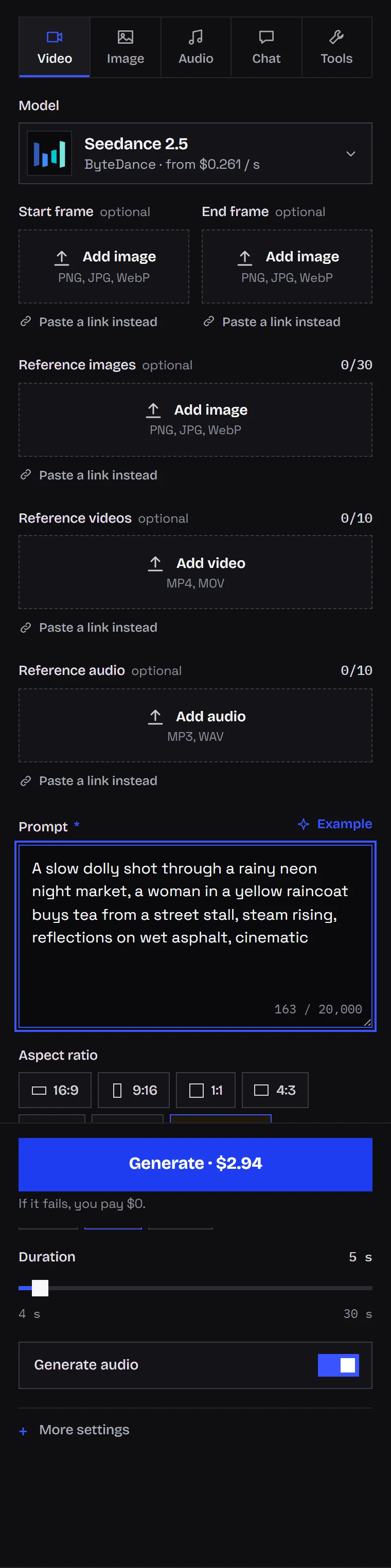
One command gives Claude Code the ability to render video, images and songs: claude mcp add --transport http kadraris https://kadraris.com/mcp --header "Authorization: Bearer sk-kd-...". After that you can write "make a 5-second vertical Seedance 2.5 clip" and the agent finds the model, quotes the price and, once you agree, starts the job. Seedance 2.5 is from $0.261 per second, and a failed generation is free.
This guide covers everything from an empty account to a video file in your project: a capped key, the connect command on Windows and macOS, a free connection test, the first clip, prompts to copy, standing rules, and the errors that come up most.
Why a coding agent needs a media server
Claude Code lives in your terminal. It reads files, runs commands and edits code, but it cannot paint a picture or film a scene, because the language model behind it outputs text.
MCP (Model Context Protocol) is the standard way to hand an agent extra tools. You register a server once; from then on Claude Code knows which tools exist, what they do and what parameters they take. When one would help, it asks you before calling it.
The Kadraris server exposes, among others:
| Tool | What it does |
|---|---|
search_models | finds models for a task (text-to-video, image edit, music) with price and key inputs |
get_model | the exact inputs of one model: ratios, resolutions, lengths |
estimate_cost | quotes a job and returns a confirm_token, charges nothing |
generate | starts the job, optionally with that token |
wait_for_task, get_task | follow a running job, get file links and the final cost |
upload_file | turns a local file into an input URL for a model |
get_balance | shows what is left on the account |
chat | asks another chat model, for example Gemini or GPT |
Claude still writes your code. The server gives it a way to produce media.
Where this is useful
- Sites and apps. While the agent builds a landing page, it also renders the hero background, a few icons or a short clip for the explainer section.
- Short-form video from a script file. You write the scenes in a markdown file and the agent renders them one at a time into a folder.
- Prototypes and pitches. Placeholder art for a game or a deck in minutes, without opening a browser.
- Automation. The agent tries parameters over MCP first, then writes a script that calls the Kadraris API with what worked.
Prefer clicking? Everything here also works in Kadraris Studio. MCP is for people who are in the terminal anyway.
Make a key the agent cannot overspend
- Create an account and confirm your email.
- Add funds in the dashboard. The minimum is $10, there is no subscription, and the balance does not expire.
- Open API keys.
- Name the key, for example
claude-code-mcp. - Under Monthly limit, enter the most the agent may ever spend in a month, say
15. - Press Create key and copy the
sk-kd-...value. You will only see it once.
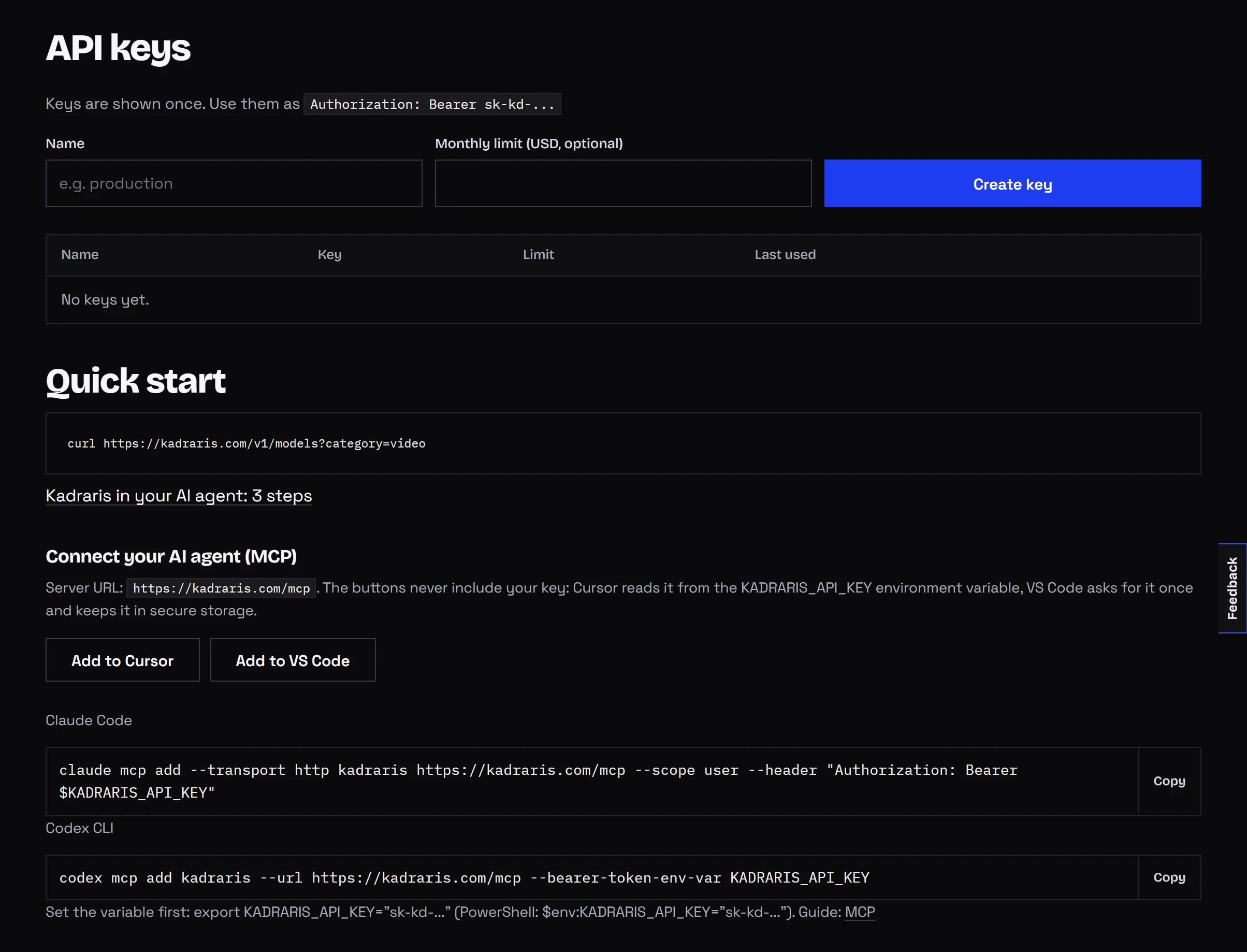
Of everything in this guide, the cap matters most. A loosely worded prompt can lead an agent with a video tool to start several clips in a row. Once the key reaches its cap, Kadraris replies 403 and the balance stops moving.
Connect the server
No Claude Code yet? The install commands are in Claude Code cost per token.
Windows PowerShell
In your project folder, paste this with your key:
claude mcp add --transport http kadraris `
  https://kadraris.com/mcp `
  --header "Authorization: Bearer sk-kd-..."
macOS and Linux
claude mcp add --transport http kadraris \
  https://kadraris.com/mcp \
  --header "Authorization: Bearer sk-kd-..."
Out of the box the server is only active in the folder where you added it. For every project, add --scope user:
claude mcp add --transport http kadraris \
  https://kadraris.com/mcp --scope user \
  --header "Authorization: Bearer sk-kd-..."
Check the connection for free
claude mcp listkadraris should be listed as Connected. Inside claude, /mcp shows the server and its tools. Then a test that costs nothing:
Call get_balance on the kadraris server and tell
me how much is left.
A dollar amount in the reply means you are ready.
The first clip, step by step
Paste into Claude Code:
Render a vertical 9:16 Seedance 2.5 clip, 5 s,
720p: a barista pouring latte art in a small cafe,
morning light from the window, steam rising.
Run estimate_cost first and wait for my OK.
What the agent does:
- Calls
get_modelforseedance-2.5to get the right parameter names. - Calls
estimate_costand shows the amount. Quoting is free. - Waits for your yes, then asks permission to call
generate. You see the exact prompt and settings it is about to send. - Video usually takes longer than
generatewaits, so the agent receives a task id (task_...) and follows it withwait_for_taskorget_task. - When the task reads
succeeded, you get the MP4 link and the final cost.
If the agent stops before the task is done, say "check the task". If the job fails, the amount held for it returns to your balance in full.
Getting the file into the repo
Result links expire, so ask straight away:
Save that video to media/latte-916.mp4.Claude Code downloads it with curl or Invoke-WebRequest and the file sits next to your code.
Prompts worth copying
- "Create a one-page bakery site in
index.htmland render a 16:9 hero image for it with Nano Banana Pro. Quote first." - "List video models that do 1080p, sorted by price per second, top five."
- "Make three 1:1 app icon options with GPT Image 2.5 and put them in
assets/icons/." - "Read
scenes.md, turn every scene into its own 5-second 9:16 clip, and give me the total before you start." - "Write a short verse about Monday mornings and turn it into a song with Mureka V9."
- "Use the chat tool to get Gemini 3.6 Flash's opinion on this component."
Current rates for the models mentioned:
| Model | Rate |
|---|---|
| Seedance 2.5 | from $0.261 per second |
| Nano Banana Pro | from $0.07 per image |
| GPT Image 2.5 | $0.05 per image |
| Mureka V9 | $0.15 per song |
Per-second numbers for every video model are in AI video cost per second.
Standing rules with AGENTS.md
Typing "quote first" into every prompt gets old. Pull the ready-made API notes into the project and add your rules to them:
curl -fsSL https://kadraris.com/agents.md -o AGENTS.md
echo "@AGENTS.md" >> CLAUDE.md
PowerShell:
Invoke-WebRequest -Uri "https://kadraris.com/agents.md" `
  -OutFile "AGENTS.md"
Add-Content -Path "CLAUDE.md" -Value "@AGENTS.md"
At the end of AGENTS.md, write something like "Quote every video and wait for approval. Save media in media/." More in the AGENTS.md docs.
Who pays for what
MCP does not care which provider runs Claude Code itself. You can code on an Anthropic subscription and use Kadraris only for media.
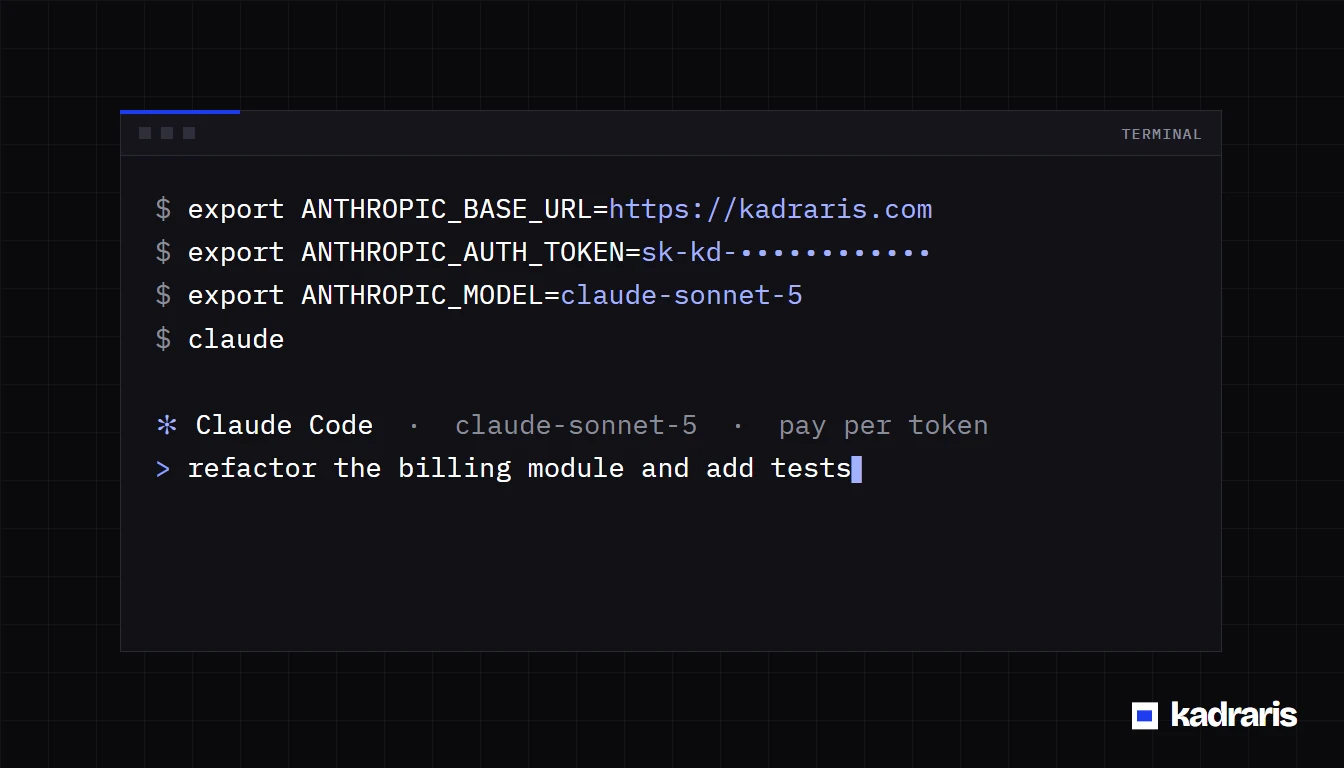
You can also run Claude Code on Kadraris tokens from the same balance, so one account covers both the conversation and the renders. Setup: Claude Code docs and Claude Code with a custom base URL.
My advice is two keys, one for Claude tokens and one for MCP. The dashboard then splits what you spent on code from what you spent on video.
Guardrails
- Never "always allow"
generate. Let Claude Code ask before each call. Always allowingsearch_models,get_model,estimate_costandget_balanceis fine, because they cost nothing. - Keep the key out of git. With
--scope project, Claude Code writes the config into.mcp.jsonin the repo, and the key goes into your next commit. Stay with the default scope or--scope user. - The cap on the key limits spending whatever the agent decides to do.
- A failure costs $0. If the model rejects the prompt or errors out, the money comes back.
Errors you may see
| Symptom | Fix |
|---|---|
Failed to connect in claude mcp list | check the URL (https://kadraris.com/mcp) and the header: Bearer, a space, the key |
401 | wrong or revoked key; make a new one, then claude mcp remove kadraris and add it again |
402 | balance too low, add funds |
403 | the key reached its monthly cap; raise it or use a new key |
422 | a value outside the model's range, such as a clip that is too long; have the agent run get_model and correct it |
| tools missing in the agent | quit and restart claude, then check /mcp |
Questions
Do I need a Claude Pro or Max plan for this?
No. Claude Code can run on an Anthropic plan or on Kadraris tokens, and the MCP server works with both. The renders are always paid from your Kadraris balance.
What does a 5-second clip made through Claude Code cost?
The same as in Studio or the API: for Seedance 2.5, 5 × from $0.261 per second. On top of that come the Claude tokens for the conversation. estimate_cost shows the clip price before anything starts.
Can I use the same server in Codex, Cursor or Claude Desktop?
Yes. Configs for Codex CLI, Cursor, VS Code, Cline and Claude Desktop are in the MCP docs, and Codex has a separate walkthrough: Codex CLI with Kadraris MCP.
How do I send the agent my own photo as a start frame?
Ask it to use upload_file on the local image first. The tool returns a URL that the agent then passes as the image input of the video model.