
Using Kling With No Monthly Plan: App Credits vs Per-Second Billing
Kling AI without a subscription: how app credits expire, what a clip costs on an underused plan, and when per-second billing on Kadraris fits better.
 Piotr Olszewski2026-10-227 minPolski
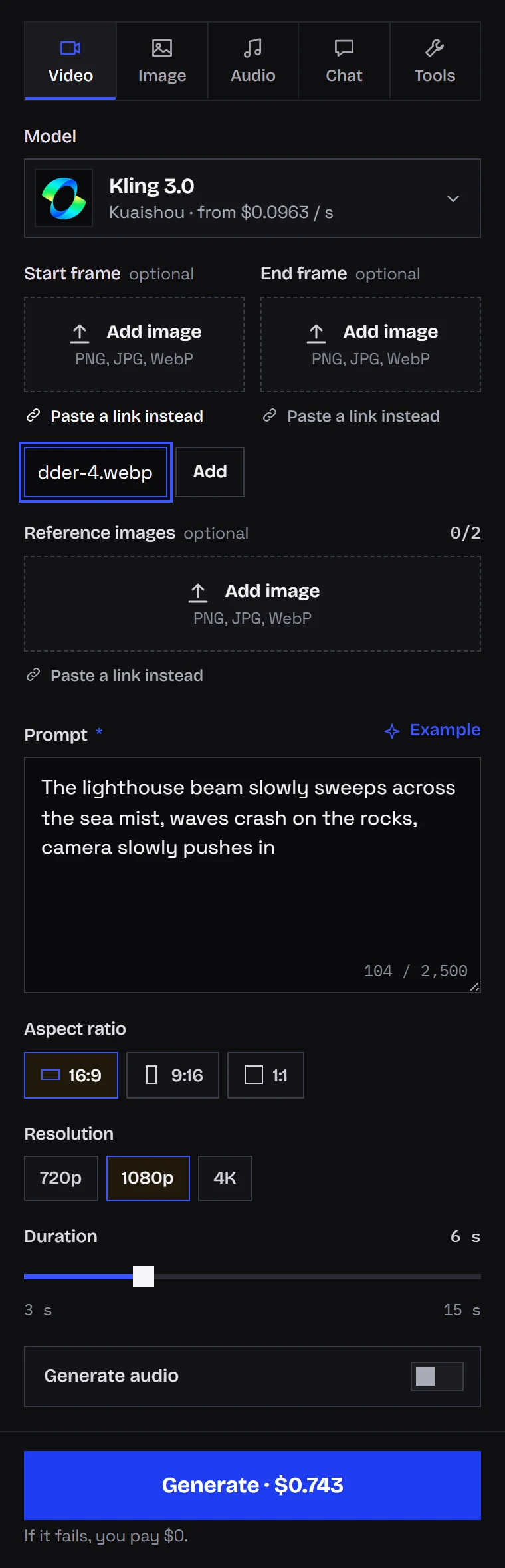
Kling does not require a subscription. Kling 3.0 runs on Kadraris for from $0.0963 per second; Kling 3.0 Turbo and Kling 3.0 Motion Control use the same per-second logic, all from a prepaid balance with no expiry date. The Kling AI app works differently: you buy a plan, and the credits it gives you last one month from issue.
A plan makes sense when you use up its allowance every month. Per-second billing is the better match for uneven workloads, projects that mix models, and anything built on the API. This post is about the billing model. The rate card for 720p, 1080p and 4K is in Kling 3.0 API pricing.
The hidden cost of unused credits
Any plan credit left at the end of its month is gone. That makes the true price of each clip a function of your own output, not of the credit table:
real cost per clip = plan price / clips you made that month
A neutral example: a plan covers 40 clips and this month you made 20. Each of those clips cost you double what the credit table suggests. Only when all 40 get made does the plan deliver its advertised value.
Per-second billing has no such gap. Five seconds at 720p cost 5 × from $0.0963 per second on day one and on day thirty alike, and money you do not use simply waits.
How Kling app credits are issued and used
Inside the Kling app, Kuaishou offers plans billed monthly or yearly, each with an allowance of credits. Their lifetime differs by type. Summary of the kling.ai credits policy, checked October 2, 2026:
- Subscription credits, issued each month of a plan: valid 1 month from issue.
- 7-day membership credits, issued when that membership starts: valid 7 days.
- Login credits, for the first login of the day: valid until midnight.
- Purchased credits, from a one-off pack: valid 2 years.
- Promotional credits, from campaigns: valid per campaign rules.
Three rules in the same policy matter for cost:
- The credits that expire soonest are spent first. A clip uses up daily and subscription credits before touching the two-year purchased ones.
- Annual plans do not hand out a year of credits at once. They arrive month by month, so you cannot stockpile them for one big project.
- Failures are refunded. If a generation fails, its credits come back.
For developers, Kuaishou runs a different platform whose prepaid API packages are listed at kling.ai/dev/pricing; the app's plan prices are on kling.ai itself. Promotions and per-mode credit costs change often, so check before buying.
The Kling app tiers
My snapshot of the app tiers, taken on kling.ai on September 18, 2026 with monthly billing selected:
- Basic (free): watermarked output, personal use only, and neither 1080p nor 4K.
- Standard: 660 credits per month.
- Pro: 3,000 credits per month.
- Premier: 8,000 credits per month.
- Ultra: 26,000 credits per month.
Current prices and promotions are on kling.ai. Kadraris has no free plan or starter credit, so even clip number one is paid; in exchange the balance never lapses and nothing renews on its own.
| Kling AI app | Kadraris | |
|---|---|---|
| How you pay | a plan's credit allowance | dollars per rendered second |
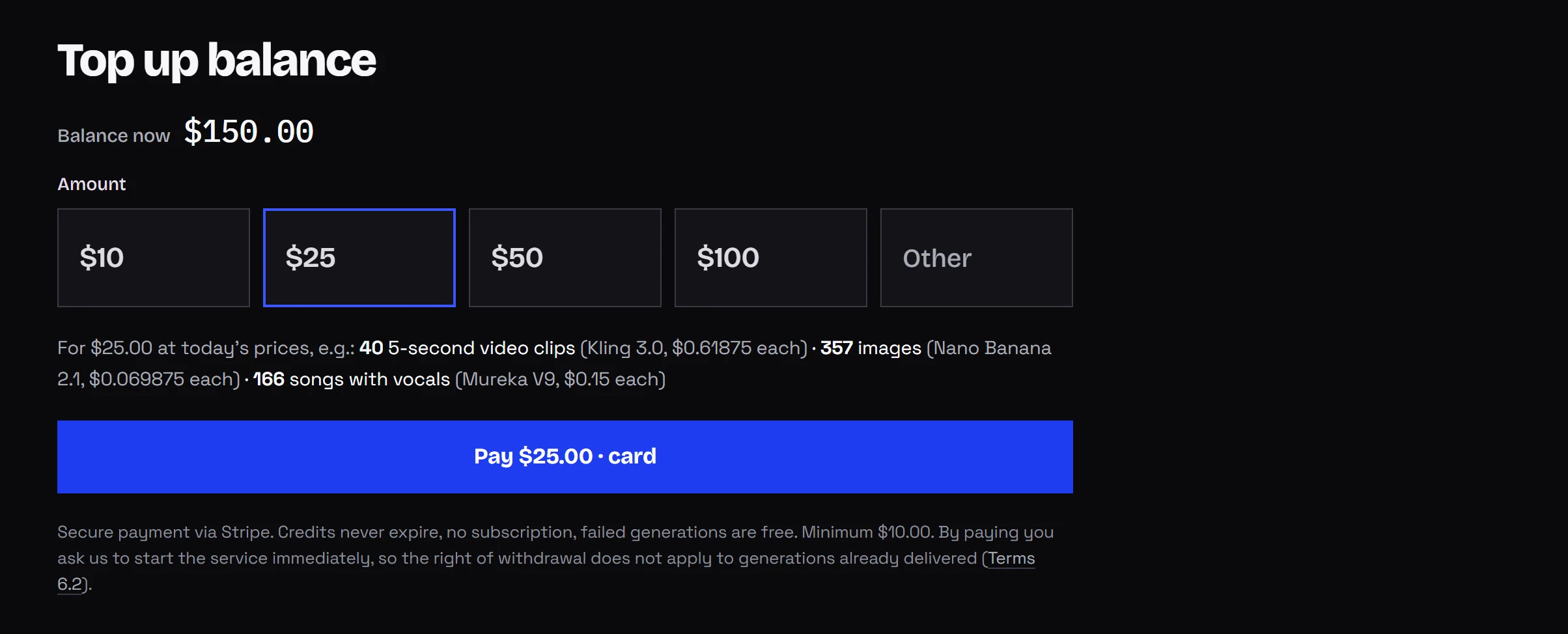
| Smallest spend | one month of a plan | a $10 top-up |
| Unused money | lost after a month | kept, no expiry |
| API | Kuaishou's separate developer offer | one key for the whole catalog |
| Model choice | Kling family | Kling plus Veo, Seedance, MiniMax and more |
Which billing model fits you
- Kling every day, no other models: the app plan wins. You empty the allowance, and bigger tiers make each credit cheaper.
- First access to new Kling versions and app-only tools: also the app plan. Releases land there first; as I write, Kling 4.0 (announced September 28, 2026) has not reached Kadraris.
- Irregular output, some weeks busy and some empty: per-second billing. An idle month costs $0.
- Projects that also need Seedance, MiniMax or Veo: per-second billing, since a single balance replaces several plans.
- Client work: per-second billing. Every clip has its own price you can invoice.
- Software or automations: per-second billing. Studio and the API draw on the same key and funds.
- Just curious: the free tier in the Kling app, with its limits, or a $10 top-up here.
You can also run both: the entry-level app plan for everyday experiments, and per-second billing for a large job or a 4K hero shot, so you never upgrade a plan just for a single month.
Kling models billed per clip on Kadraris
| Model | Charged per | When I use it | Price |
|---|---|---|---|
| Kling 3.0 | output second | dialogue, people, 4K, sound | from $0.0963 per second |
| Kling 3.0 Turbo | output second | short turnaround | from $0.277 per second |
| Kling 3.0 Motion Control | input clip second | my own motion on a character photo | $0.249 per second |
| Kling 2.6 Motion Control | input clip second | low-cost dance and movement tests | $0.138 per second |
Watch the name: Turbo is not the budget option here. It renders faster, yet its per-second price sits above 720p Kling 3.0, and sound and 4K are missing. More in Kling 3.0 vs Kling 3.0 Turbo.
Three sample months
The same rules for three kinds of users. The live rates fill in the amounts:
| Who | Output per month | Cost on Kadraris |
|---|---|---|
| occasional creator | 6 clips of 5 s, 720p | 30 × from $0.0963 per second |
| short-form creator | 20 clips of 10 s, 720p | 200 × from $0.0963 per second |
| agency | 15 Motion Control 3.0 clips of 10 s | 150 × $0.249 per second |
The "from" rate is 720p without sound. At 1080p it is about a third higher, at 4K nearly five times, and audio multiplies the 720p and 1080p rates by roughly 1.4 to 1.5 (at 4K sound adds nothing). In Motion Control, pro quality costs more than std. You always see the exact sum before generating. For other video models, see AI video cost per second or run your own numbers in the cost calculator.
Controlling spend without an allowance
With no plan, nothing stops you at a monthly limit, so build the brakes yourself:
- Look at the price first. Studio shows it on the form; the API returns
estimated_costas soon as you submit. - Draft short and small. 5 seconds at 720p until the shot works, then 1080p or 4K for the keeper.
- Skip audio if music goes on in the edit.
- Top up in small amounts. When the balance runs out, the API returns
402and nothing more renders. - Failures are free. A
failedtask costs nothing and the hold comes back in full.
Per-second Kling from code
After you sign up, create a key in the dashboard. Check the balance, then send a job:
# how much is left
curl https://kadraris.com/v1/balance \
  -H "Authorization: Bearer $KADRARIS_API_KEY"

# 5 s vertical clip, 720p, silent
curl https://kadraris.com/v1/generate \
  -H "Authorization: Bearer $KADRARIS_API_KEY" \
  -H "Content-Type: application/json" \
  -d '{
    "model": "kling-3.0",
    "input": {
      "prompt": "Handheld shot of a barista pouring latte art in a small cafe, morning light through the window",
      "duration": 5,
      "resolution": "720p",
      "aspect_ratio": "9:16",
      "generate_audio": false
    }
  }'
The 202 response includes estimated_cost. Get the clip from GET /v1/tasks/{id} or by webhook. Holds and charges are explained in the billing docs, and Kling is set against other models in the AI video API comparison. The full video lineup is on the AI video generator page.
Questions
Can I save Kling app credits for a big project later?
Only purchased packs, which last two years. Subscription credits arrive monthly and expire a month after issue, even on an annual plan.
What is the smallest amount I can spend to try Kling 3.0 on Kadraris?
A $10 top-up. It does not expire, so whatever is left after a few test clips stays for later.
Is Kling 3.0 Turbo the cheaper choice?
No. On Kadraris it costs more per second than Kling 3.0 at 720p. You pay for faster delivery and give up audio and 4K.
Do I need a Kuaishou developer package to use Kling in my app?
Not on Kadraris. You call kling-3.0 through POST /v1/generate with the same key you use for every other model and pay per second from your balance.